Three cycles and the towels are still damp. Your energy bill climbs and the laundry backs up. Dryer repair Spokane homes can book today, Hillyard to Liberty Lake.
Call (509) 800-4948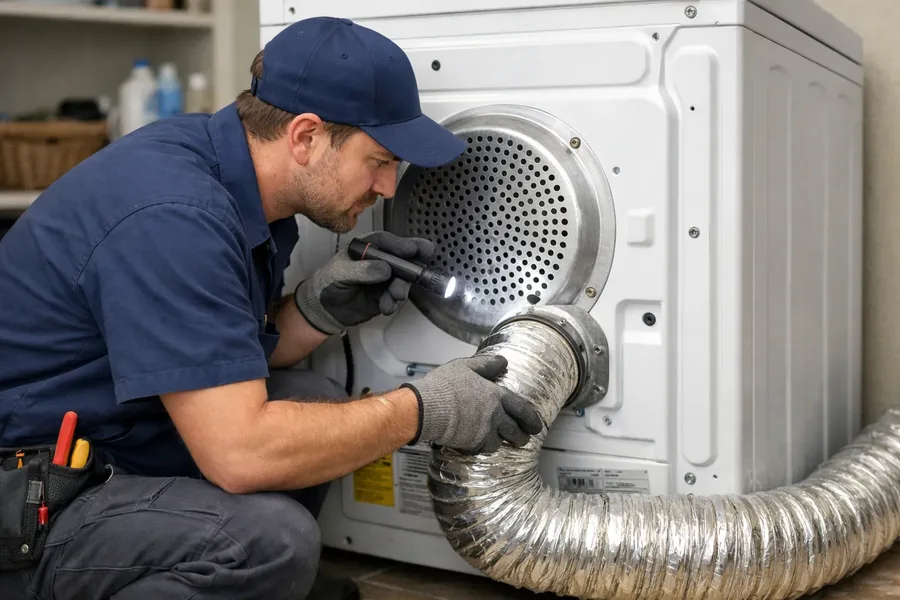
A dryer that runs but does not dry is almost never a dead dryer. It is heat, or airflow, or a switch that thinks the door is open. Three failures cover most of what we find in Spokane basements and laundry closets, and two of them are cheap.
No-shows, unreturned calls, parts that go quiet. Anyone searching dryer repair near me is really asking whether the person will actually turn up, so here is the whole process in four steps.
Someone answers the phone Monday through Saturday, 7:00 AM to 8:00 PM. You get a two-hour window rather than a vague afternoon. A text goes out when we leave the job before yours, so you can keep working.
Parts availability is confirmed with the distributor before the quote reaches you, tax included. That number does not change without your approval. If a part is discontinued on your model, you hear it the same day and we say so rather than stalling.
The fuse is a safety device that did its job. Swapping it and walking away leaves the real fault, a blocked or crushed vent run, still in place. That traps heat against the element and the cabinet, shortens the element's life to months, and in a lint-packed duct it becomes a fire risk. Clear the run first, every time.
A dryer that runs hot and slow is a safety question as well as a laundry one.
The clearest sign is drying that takes two or more cycles. Hold a hand at the outside hood while the dryer runs. Weak airflow or a flap that barely lifts means the duct is restricted, and the vent should be cleared before any part is replaced.
Sources: Fire Engineering summary of the USFA dryer fire report
Spokane's housing stock is old in exactly the places people do laundry. ZIP 99205 alone has 8,717 units built in the 1930s and 40s. On the South Hill, 99203 counts 1,686 homes built before 1940 against only 181 built after 2000. Those houses put the laundry in a deep basement, which means a long vent run.
A basement dryer often pushes air fifteen to twenty-five feet with two or three elbows before it reaches the rim joist. Every elbow costs you the equivalent of several feet of straight duct. Add a crushed foil transition hose behind the machine, which happens the moment somebody shoves the dryer back against the wall, and airflow drops far enough that the cycle doubles and the thermal fuse eventually goes. We clear and test the run as part of the repair, but we do not re-route or build new ducting through walls and roofs. That is a contractor's job and we will say so.
Spokane sees 133 nights a year at or below 32F and 33.6 days that never climb above freezing, with a December normal low of 24.3F and January at 24.7F. Warm, wet exhaust hitting that air condenses right at the exterior hood, and the damper flap freezes part-open or lint-glued shut. Snowfall normals sit at 45.4 inches, and in December 2008 the city took 61.5 inches in twenty days, which buried plenty of ground-level vent hoods entirely. Check that your hood is clear before you assume the machine is broken.
Find your symptom, then see what we check first.
| Symptom | Likely cause | Safe check first | Call us when |
|---|---|---|---|
| Runs but no heat | Heating element, gas igniter, thermal fuse | Check the breaker pair or gas supply | Power and gas are fine and it stays cold |
| Takes several cycles to dry | Blocked vent, restricted exhaust hood | Pull the lint screen and check the outside flap | Vent is clear and drying is still slow |
| Does not start at all | Door switch, thermal fuse, start switch | Check the outlet and breakers | Outlet is live and nothing happens |
| Squeals or thumps | Drum roller, idler pulley, belt | Spin the drum by hand with the power off | Any squeal or thump, since it worsens |
| Stops mid-cycle | Overheating, cycling thermostat, vent restriction | Clean the lint trap and vent | It repeats after a clean vent |
| Burning smell | Lint at the burner or element, failing motor | Stop using it and unplug | Always, before you run it again |
A hot or burning smell is a reason to unplug the dryer and call, not to run one more load. Lint near a heat source is a fire risk.
On an electric dryer it is usually the heating element or a blown thermal fuse. On gas it is often the igniter or flame sensor. A blocked vent can also trip the fuse, so we clear the vent run before replacing anything.
These steps keep the visit short and the repair accurate.
In the Valley, our Spokane Valley appliance repair team covers the same dryer faults, and the refrigerator repair page lists what else we service.
Most dryer faults come down to a short list of wear parts.
| Part | What it does | Sign it has failed |
|---|---|---|
| Thermal fuse | Cuts power if the dryer overheats | Dead dryer or no heat, often after a blocked vent |
| Cycling thermostat | Holds drying temperature | Too hot, too cool or stops mid-cycle |
| Heating element (electric) | Makes the heat | Tumbles but stays cold |
| Igniter and flame sensor (gas) | Light and prove the burner | Glow but no flame, or heat that cuts out |
| Drum rollers and idler pulley | Carry and tension the drum | Squeal, thump or rumble |
| Drive belt | Turns the drum | Motor hums but drum does not turn |
| Blower wheel | Moves air through the vent | Long dry times with a clear duct |
| Door switch | Tells the dryer the door is shut | Will not start |
| Drum felt seal | Seals the drum edge | Lint inside the cabinet, burnt smell |
| Moisture sensor | Ends the cycle when clothes are dry | Cycles end early or run on |
Squealing usually means a worn idler pulley or drum roller, and a rhythmic thump points to a flat spot on a roller or a loose belt. Grinding can mean a failing motor or blower. Stop using it if the noise is new and loud, because worn parts get worse and can damage the drum.
Clearing a vent run is a different job from replacing a part. If drying times improve after the duct is cleared, you may not need a part at all, and we will say so in the written diagnosis.
Some dryer jobs are safe for a homeowner and some are not.
Empty the lint screen, wipe the screen with a damp cloth, check the breaker pair, and look at the outside hood flap.
Anything inside the cabinet: fuses, elements, igniters, gas valves and belts. These involve live power or gas.
A burning smell, a tripped breaker that returns, or any gas smell. Unplug the dryer first.
The heat source decides which parts we carry and which checks come first.
| Electric dryer | Gas dryer | |
|---|---|---|
| Main heat part | Heating element | Igniter, flame sensor, gas valve coils |
| Power needed | 240 volt circuit with a double breaker | 120 volt plus a gas line |
| Common dead-heat cause | Element or thermal fuse | Igniter or flame sensor |
| Safety check | Vent clearance and fuse | Gas smell check, vent and igniter |
If you smell gas, do not touch switches or the dryer. Leave and call your gas utility from outside. We only work on a gas dryer once the smell is resolved.
At least once a year, and any time drying times stretch out. Long or bent vent runs collect lint faster. Cleaning the lint screen every load helps, but it does not clear the duct behind the machine.
Clothes still wet after a wash cycle? That points back to the washer not spinning out water, which the dryer then has to cope with. Mixed problems are normal, so see our Spokane appliance repair page for the full list we cover.
You will find us across the city and out into the county. Inside Spokane that is 99201 downtown and West Central, 99202 East Central and South Perry, 99203 the South Hill and Manito, 99204 Cliff-Cannon and Browne's Addition, 99205 Shadle, Audubon and Emerson-Garfield, 99207 Bemiss and Hillyard, 99208 North Spokane, Five Mile and Indian Trail, 99218 Wandermere and Country Homes, 99223 Moran Prairie and Glenrose, and 99224 across the West Plains and Latah Valley.
Valley coverage runs 99206, 99212, 99216, 99217 and 99037 Veradale. Beyond that we serve Spokane Valley, Liberty Lake, Cheney, Airway Heights, Mead, Millwood, Otis Orchards-East Farms, Post Falls ID, Medical Lake, Deer Park, Nine Mile Falls, Colbert and Suncrest. Anyone typing dryer repair near me from those ZIPs is inside the area we cover every day.
A dryer problem almost always shows up as a symptom first: no heat, slow drying, a drum that will not turn or a strange noise. Each points to a short list of parts, which is why a clear description helps.
Gas and electric dryers share the same drum and belt faults but differ on heat, so we confirm the fuel type before ordering anything.
On electric models it is usually the heating element or thermal fuse. On gas models it is the igniter or gas valve coils. A clogged vent can also trip the safety fuse.
Both brands commonly show heat and sensor faults. We read the error code and test the part, instead of guessing.
Larger dryers use heavier motors and controls. Call with the make and model so we can confirm parts and access.
A dryer line that is kinked or clogged restricts airflow and heat, which shortens parts life.
The usual causes are a failed heating element, thermal fuse or sensor. A technician tests each one with a meter.
We service some commercial dryers. Call with the make and model so we can confirm before booking.
Yes. Trapped heat trips the thermal fuse, which cuts heat as a safety measure.
Thermal fuses, cycling thermostats, door switches, drive belts, drum roller kits, idler pulleys and the most common electric heating elements ride with us. Those cover the large majority of dryer calls in Spokane on the first visit. Gas igniters, blower housings and control boards are model-specific and get ordered once we know your exact model number. We confirm the part with the distributor before the quote goes out, so you never approve a repair that depends on something nobody can ship.
Ninety days on parts and labour for the repair we performed. If the same part fails the same way inside that window, we come back and there is no charge. A different fault elsewhere in the machine is a separate job, and we will tell you that plainly instead of quietly rolling it into a bill. The terms go on your invoice so there is nothing to argue about later.
We service six appliances: washers, dryers, refrigerators, dishwashers, ovens and ranges, and freezers. No furnaces, no heat pumps, no air conditioning, no microwaves, no garbage disposals, and no installations. On dryers we will clear and test an existing vent run, but we will not cut new duct through walls, roofs or crawlspaces, and we do not run new gas lines. Those are licensed trades and you want the right person doing them.
Stop using it and unplug it, or shut the gas valve on a gas unit. A hot or scorched smell means heat is not leaving the cabinet, which usually points at a blocked vent, a packed lint trap housing or a failed cycling thermostat. Lint is the fuel and trapped heat is the ignition source, so this is one of the few appliance faults worth treating as urgent. Call us and we will get you in the same day where we can.
Yes, and they are common in Browne's Addition apartments and Logan-area rentals where floor space is tight. Stacked units take longer because the dryer half often has to come off the washer to reach the blower and the element. That extra labour is in the written quote up front, not added at the end. If your unit is built into a closet with no clearance, tell us on the phone so we bring the right hands.
Most dryer jobs finish in forty-five to ninety minutes once the technician is on site. A thermal fuse or door switch is closer to twenty minutes; a blower wheel or a full drum teardown for rollers and a belt is closer to two hours. Vent clearing adds time depending on the length of the run and how many elbows it has. We tell you the expected time when we quote so you can plan your day around it.
Washington does not license appliance repair at all, so no company in this state can honestly claim to hold one. RCW 18.27 covers contractors working on buildings and real property, and RCW 18.27.090 exempts finished goods that never become part of a structure, which is what a freestanding dryer is. What we carry instead is a City of Spokane business licence, a Washington UBI, Labor and Industries coverage, liability insurance, and a separate Spokane Valley licence because the Valley requires its own. Those are the four things worth asking any company for.
1. Call with the brand, whether it is gas or electric, and what the machine is doing. 2. Choose a two-hour window and watch for the text when we leave the job before yours. 3. Approve the written total, or take the diagnosis and stop there.
Call (509) 800-4948
No deposit, no card held on file, and no feedback request until the machine has earned it. If your dryer is past its useful life, we will say so on the first visit rather than sell you a repair.
Yes, the part is inexpensive, but only after the cause is found. A fuse blows because the dryer overheated, usually from a blocked vent. If we replace it without clearing the duct, it can blow again, so we check airflow first.
You can clean the lint screen and check the breaker and outside hood. Work inside the cabinet involves live power or gas, so leave fuses, elements, igniters and belts to a technician. Always unplug the dryer first, and shut off the gas valve on a gas model. If you smell gas or burning, do not start it again.
A squeal is often a worn idler pulley or drum roller, a thump a flat roller or loose belt, and grinding a motor or blower fault. New, loud noise is worth a call before the drum is damaged. Stop the dryer and check the drum for coins or loose items first. If the noise remains with an empty drum, book a diagnosis.
At least once a year, and any time drying slows. Long or bent duct runs collect lint faster. The lint screen does not protect the duct behind the machine. Cleaning is also due after a move or when a new dryer is installed on an old duct. The outside hood should open freely and be free of lint every time the dryer runs.
Often yes. Belts, rollers, thermostats, elements and igniters are common parts. We give you the written total and compare it to a new dryer so you decide. Dryers typically last around 14 years, so a ten-year-old machine is usually mid-life. Parts for common models are easy to get, and we confirm availability before quoting.
Cold intake air and a damp laundry room slow drying, and a restricted vent makes it worse. If clothes need two cycles in every season, check the duct and outside hood before blaming the machine. Overloading the drum also slows drying. Try smaller loads and clean the lint screen on every load before calling.