
Preheat drags. Dinner comes out raw in the middle. Oven repair in Spokane starts with a thermometer in the cavity and a written total, not a parts cannon.
Call (509) 800-4948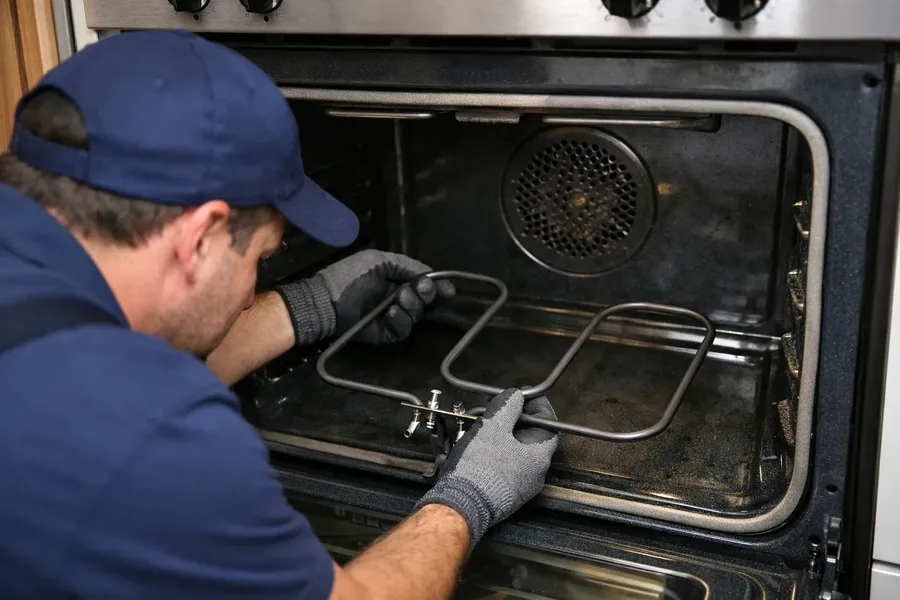
Most calls land on one of three parts. Prices below are ranges, installed, parts and labour together, and gas costs more than electric to put right.
Four steps, and you know the total before anything comes apart.
You get a two-hour arrival window, not a whole day, and a text when we leave the job before yours.
Availability is confirmed with the distributor before the quote goes out. One total in writing, parts, labour and tax, unchanged without your approval.
The work is covered 90 days, parts and labour. We check the cavity against a probe thermometer first, because a range that lights is not a range that holds 350F.
This city cooks in houses built for a different stove. That is a wiring and gas question, and it shows up on the invoice.
In 99203, the South Hill and Comstock, 1,686 homes went up before 1940 and only 181 after 2000. Shadle and Emerson-Garfield in 99205 hold 8,717 units from the 1930s and 40s. Manito bungalows date to 1904 and Hillyard worker housing to 1904 through 1912. None of those kitchens were designed around a 40-amp range.
Two houses on one block often run different fuel, because conversions happened piecemeal over a century. Gas ranges fail at the igniter and spark module. Electric ranges fail at the element, sensor and burner switch, and a tired 240V terminal block makes a healthy element look dead.
Ovens fail when they finally get used hard. That means the run from the Spokane County Interstate Fair on September 11 to 20 2026, through Green Bluff harvest baking on roughly 30 member farms north of town, into Thanksgiving. A range that coasted at 350F all summer gets asked for four hours at 425F, and the weak element quits that week.
Gas and electric ranges fail in different ways.
| Symptom | Likely cause | Safe check first | Call us when |
|---|---|---|---|
| Oven does not heat (electric) | Bake element, control, sensor | Look for a visible break or blister on the element | The element looks fine and stays cold |
| Oven does not heat (gas) | Igniter, safety valve | Look for a glowing igniter | The igniter glows but no flame lights |
| Temperature runs off | Temperature sensor, calibration | Check with an oven thermometer | Reading is far from the setpoint |
| Burner will not light | Spark module, burner switch | Clean burner ports and caps | No clicking, or clicking without flame |
| Door will not close | Hinges, door seal | Check the door for sag or debris | The door will not seat |
| Control panel dead | Control board, relay | Check the breaker | Power is on and the panel is blank |
If you smell gas, do not use the oven or any switch. Open a window, leave, and call your gas utility. We repair once the smell is resolved.
Electric ovens most often have a failed bake element or temperature sensor. Gas ovens often have a weak igniter that glows without opening the safety valve. A glowing element or igniter that does not reach temperature tells us which part to replace.
Four steps from your call to a working oven.
Give us the brand, fuel type and symptom.
We test the element, igniter or sensor and name the failed part in writing.
You approve the number before work starts.
The repair carries 90 days parts and labour.
Often yes, when the part is a common one such as an element or sensor. We confirm availability before quoting, so you know up front whether the repair finishes on the first visit or needs a part order.
Range repair covers the stovetop as well as the oven.
| Cooktop type | Common fault | What we check |
|---|---|---|
| Gas burners | Clicks but will not light | Blocked ports, wet cap, spark module |
| Electric coil | Coil will not heat | Burner receptacle and infinite switch |
| Smooth glass top (radiant) | One zone cold or stuck on | Infinite switch, hi-limit switch, element |
| Induction | Error or no heat | Pan type, control board, wiring |
An element that has shorted to ground is the usual cause, along with worn wiring at the terminals. Do not keep resetting the breaker. Switch the oven off at the panel and book a diagnosis.
A named part and a test result is what separates a diagnosis from a guess.
| Part | Symptom | How it is normally tested |
|---|---|---|
| Bake or broil element | Cold oven, blistered or broken coil | Visual check, then a continuity reading with the power isolated |
| Temperature sensor | Runs hot or cold, or F-code on the display | Resistance reading compared to the model spec |
| Gas igniter | Glows but burner never lights | Current draw check; a weak igniter cannot open the safety valve |
| Convection fan and motor | Uneven baking, rattle or squeal | Spin the blade by hand and listen to the motor bearing |
| Door lock assembly | Door stuck locked after a clean | Check the latch motor and switch |
| Thermal fuse | Oven or control dead | Continuity reading |
| Control board | Blank or erratic display | Rule out power, sensor and relay first |
Codes that start with F usually point to the control or the temperature sensor, and the meaning changes between brands. Give us the code and model number when you call.
Preheat to 350F with an oven thermometer on the middle rack and read it after 20 minutes. A steady offset of 10 to 15 degrees is a calibration matter. A swing of 25 degrees or more, or a reading that drifts, points to the sensor or control and needs a diagnosis.
Know which type you own before you call.
| Gas range | Electric range | |
|---|---|---|
| Heat source | Igniter and safety valve | Bake and broil elements |
| Common failure | Weak igniter | Burned element |
| Surface burners | Spark module and ports | Infinite switch and burner receptacle |
| Safety step | Gas smell check first | Isolate the breaker first |
The self-clean cycle runs very hot, and it can stress the control board, door lock and temperature sensor. A fault that appears right after a clean is a typical sign. Tell us when the problem started and we will check those parts first.
Cooking and cleaning gear all in one kitchen? See our dishwasher repair and refrigerator repair pages, or the Spokane appliance repair overview.
The 50 percent rule holds here. If the fix costs more than half a comparable new range, replace it. Lifespan is commonly cited at 13 to 15 years for gas, 13 to 16 for electric, budget models around 10.
Inside the city that means 99201 West Central, 99202 South Perry, 99203 South Hill, 99205 Shadle and Audubon, 99207 Hillyard, 99208 Five Mile and Indian Trail, 99223 Moran Prairie and 99224 the West Plains.
Outside it we cover Spokane Valley, Millwood, Liberty Lake, Otis Orchards-East Farms, Cheney, Airway Heights, Medical Lake, Colbert, Mead, Deer Park, Nine Mile Falls, Suncrest and Post Falls Idaho. Same window when you search oven repair service near me from any of them.
The words stove, range, oven and cooktop get used interchangeably, but the parts differ. A burner that will not light is not the same problem as an oven that will not heat, so we start by identifying exactly what the appliance is doing.
We service gas and electric units from the major brands, including built-in cooktops and double ovens.
Burners that click but will not light usually have a dirty igniter or a failed spark module. A weak flame points to blocked ports or a regulator issue.
A failed bake element, a bad infinite switch or a cracked surface element are common.
Glass-top and induction cooktops can fail at the control board or touch panel.
A thermostat or sensor that reads wrong can cause uneven baking even when the oven heats.
Yes. We repair gas stoves and ranges, including igniter, spark module and burner faults.
A weak bake element, a drifting sensor or a worn door seal are the usual causes.
Yes, including glass-top and built-in models. Call with the brand and model.
We stock bake elements, sensors, common igniters, surface switches and hinges for the brands we see most. Two thirds of visits finish same day. Boards and safety valves get ordered, with availability confirmed before quoting.
Ninety days on parts and labour, on the repair we performed. If our part fails or the symptom returns inside that window, we come back with no second diagnostic visit. A different component failing later is a separate job, priced the same way.
We repair appliances, we do not install them and we do not touch the house. New 240V circuits, panel work, gas piping upstream of the appliance and cabinet work are somebody else's trade. Microwaves, HVAC and furnaces are off our list entirely. If your range is fine and the circuit is not, you pay nothing beyond the diagnostic.
If it lights and holds flame normally, usually yes. Smell gas at any point and you shut the supply valve, leave the house and call the utility first. An oven that lights with a thump is worth leaving alone until we arrive.
Sensors drift long before they fail outright, and the board acts on whatever the sensor reports. So we measure resistance and put a probe in the cavity rather than trusting the display. Some models recalibrate in software, which costs you nothing in parts.
Whirlpool oven repair is our most common job, with Maytag, Kenmore, GE, Frigidaire, LG, Samsung and Bosch behind it. Whirlpool Corporation owns Maytag and Amana, so those share parts. Kenmore matters too, since model prefix 110 is Whirlpool-built and 796 is LG-built.
Often yes, and more often than two years ago. Right to Repair, HB 1483, took effect January 1 2026 and requires makers to supply parts and documentation to independent shops. Elements and igniters are widely available. Boards for discontinued models end it.
It is behind the storage drawer or inside the door, and it lets us check parts before the van leaves.
Monday to Saturday, 7:00 AM to 8:00 PM, with a text when we leave the job before yours.
One figure covering parts, labour and tax, before anything is opened.
Call (509) 800-4948
Call (509) 800-4948A weak bake element, a failing temperature sensor or a poor door seal are the usual causes. If the oven reaches temperature slowly or never gets there, the part needs testing. A door that does not seal also slows preheating. Check for a gap along the seal, and use an oven thermometer to see how far off the temperature is.
Usually yes for electric ranges, since the surface burners run on separate circuits. On a gas range, stop if you smell gas, and call your gas utility from outside. Keep an eye on the burners and stop using them if you see sparks or smell burning. If the whole range is dead, switch it off at the breaker.
Food residue or moisture in the burner port is the common cause. Clean the cap and ports and let them dry. If it keeps clicking without a flame, the spark module or switch needs a look. Keep the cap seated level over the burner. Wiping spills right away stops them blocking the ports.
The cycle runs very hot and can stress the board, door lock and sensor. A fault that appears right after a clean is a typical sign. Tell us when it started. Running the cycle less often and wiping out spills first reduces strain on the parts. If the door stays locked afterwards, do not force it and call us.
Yes. Tell us the brand, model and fuel type when you book so we can plan the parts. We also repair stovetops and built-in wall ovens, and we put the fault and the part in writing before work begins. Please say whether yours is gas or electric.
Often, for elements, igniters, sensors and switches. We confirm availability before quoting, and tell you the same day if a part is discontinued. If a part is discontinued, we tell you the same day and talk through the options. Replacement is then a fair question, and we are honest about it.